
In January 2026, I.CEBERG participated in the TOKYO PROTOTYPE exhibition.
This series of articles introduces the works created by each MAISON.
For more details about the event, please visit here.
Work Overview
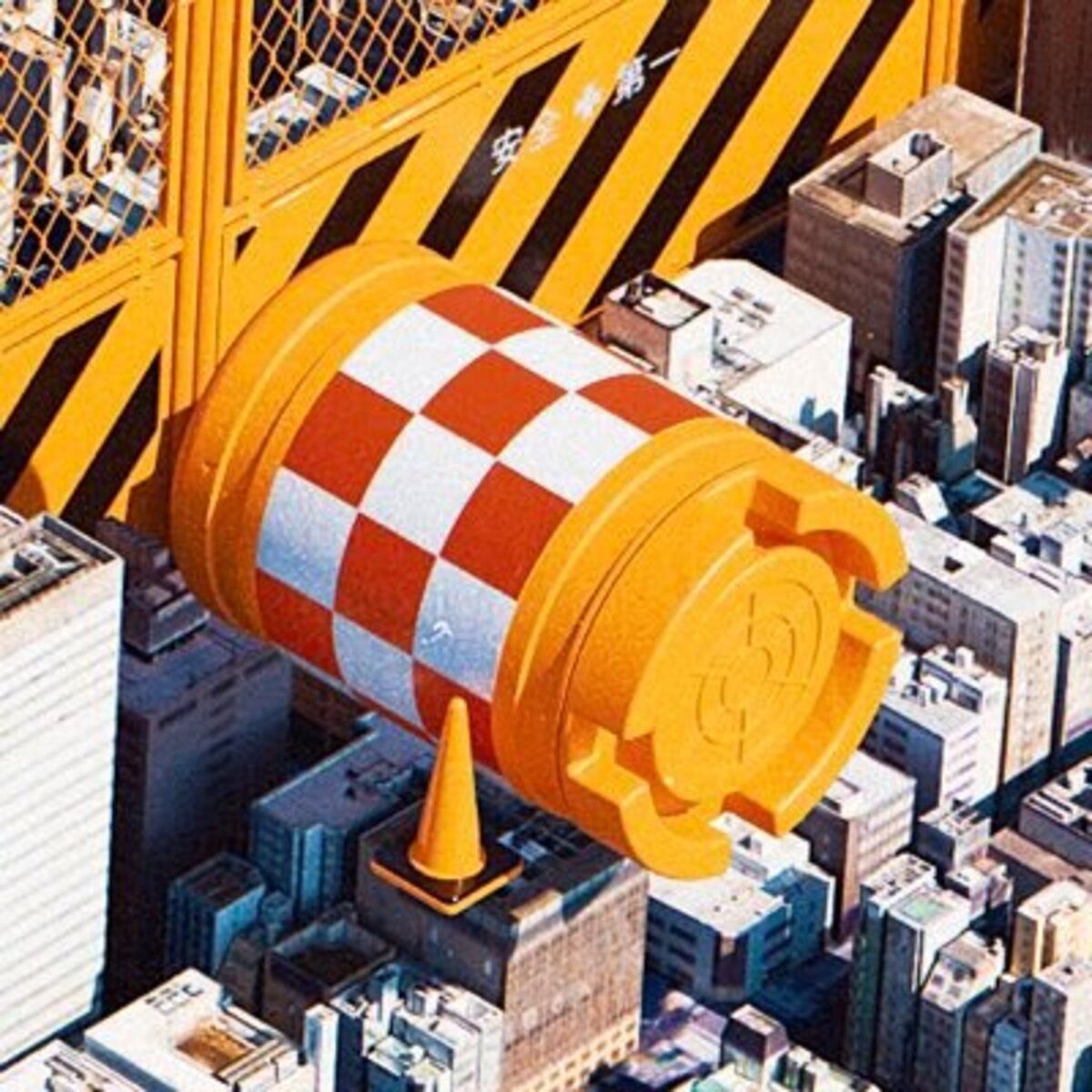
As I continued creating collages of urban landscapes through walking the city, abstract images began to emerge in response to the scenes before my eyes. By materializing these images and shaping them as if they were seeping out of the photograph, the landscape is made to stand on its own as a physical entity. The work indirectly explores the gradations that exist at the boundary between figuration and abstraction, and between 2D and 3D.


Wandering Media Boundaries
Around May 2024, I began creating collage works that combine snapshot photographs taken while walking through the city with 3D elements. Until then, I had treated 3D, photography, and graphic design as separate practices; this project emerged from a desire to place them on equal footing and to explore how far their boundaries could be blurred.

I photograph things that happen to catch my eye or spark my curiosity as if they were casual “notes,” and later revisit them to build collages. Without a fixed image of the final result, I arrange the elements intuitively, assembling them into a single image by mentally connecting the original landscapes, locations, and color tones.


The themes of “landscape and rupture” and “media and boundaries” can be traced further back to an AR work titled EVERYDAY, which I created in 2020. It was an AR motion-graphics piece that allowed viewers to experience real-world landscapes overlaid with 3D expressions that subtly deviated from everyday reality. At the time, many real-world events were canceled due to the COVID-19 pandemic, leading to a surge of interest in AR/VR content, and I was drawn to exploring AR as a mode of expression myself.
Through the process of actually producing the work, I was left with the impression that AR experiences mediated through a display rely less on the sense of reality being expanded and more on the viewer’s imagination and willingness to participate. I felt a certain dissatisfaction with a structure that asks the audience to make an effort to believe that something is happening in reality. This led me to wonder whether a more seamless form of extension might be possible, and became the starting point for my exploration of the boundary between the virtual and the real.


In addition, in Urban Reflection, exhibited in Tsim Sha Tsui, Hong Kong in 2023, visuals inspired by the city’s landscape were fragmented into narrow strips using LED panels and mirrors, and arranged throughout the space. This was an attempt to recompose a completed video not on a screen, but within the space itself. The work was conceived from a desire to create immersion by allowing viewers to circulate around the piece through an approach that is neither screen-based nor reliant on VR/AR.

A Landscape Association Game
In September 2025, during a video projection on an outdoor LED display at Tamagawa S.C., I experimented with layering colors and forms that emerged in response to the surrounding landscape. When looking at a scene, other shapes or meanings sometimes appear to overlap spontaneously—like a kind of association game. I became interested in whether it might be possible to visually share the act of wandering through the gradation between “understanding” and “not understanding,” as well as the time lag and sensation that occur at the very moment of discovery.


FRAME
As an extension of this line of inquiry, I began experimenting with collages that overlay similar associative processes onto photographs. In response to casual landscape photographs accumulated through walking the city, I translate the forms that come to mind into 3D and place them as if they are growing out from the photographic plane itself. The process feels like an extension of sketching, akin to adding a frame, or even as though I am painting directly onto the landscape.


「FRAME」は、その連想コラージュをさらに実体化した実験作である。写真はアクリル板にUVプリントし、「リアル板ポリ」としてFLAT LABに依頼して制作。オブジェクトは3Dプリンタで出力されている。


The structure functions both as a frame and as a physical support for the photograph, allowing the work to stand on its own. I wondered whether the “moment of editing”—in which the choice of photograph and the conception of form arise simultaneously—could be preserved not as an on-screen composite, but as a phenomenon that exists within physical space.
In this process, the decisions of “which landscape to choose” and “what kind of form appears there” are inseparable, occurring at the same time as a single train of thought. FRAME is also an attempt to overlay the traces of that thinking directly onto the landscape, capturing the very moment when editing comes into being.


For this exhibition, I produced two versions at different photographic scales: A4 and A0. The A4 works were fabricated using resin-based 3D printing, while the large A0 works were produced through three-axis CNC milling of expanded polystyrene. Different fabrication methods were selected according to scale, with production support provided by Maeda Giken and Kimura Foundry.

In terms of finish and surface quality, I still feel there is much room for experimentation as an act of image-making. It is not something that can be resolved as easily as sliding parameters in Redshift. Each time a form simulated in CG is translated into a physical object, subtle discrepancies emerge in scale, form, and detail. On the screen, the process inevitably feels as though everything is viewed through a single working camera, which differs from the bodily sensation of confronting the object in real space. Curiously, when I look at the finished object again through a camera, the impression comes quite close to what I experienced during the digital process.
Physical objects alone are not the sole arbiters of what is “real,” but I want to continue moving back and forth between the physical and the virtual, embracing these discrepancies as part of an ongoing process of trial and error.
Credit
Maison : Takafumi Matsunaga
Photo Print : FLATLABO
Resin 3D Print : MAEDA SHELL SERVICE
Styrofoam Cut & Fabrication : KIMURA FOUNDRY
Paint : TAKAHAMA TOSOU
Photographer : Yuya Shiokawa