
In January 2026, I.CEBERG participated in the TOKYO PROTOTYPE exhibition.
This series of articles introduces the works created by each MAISON.
For more details about the event, please visit here.
Project Overview
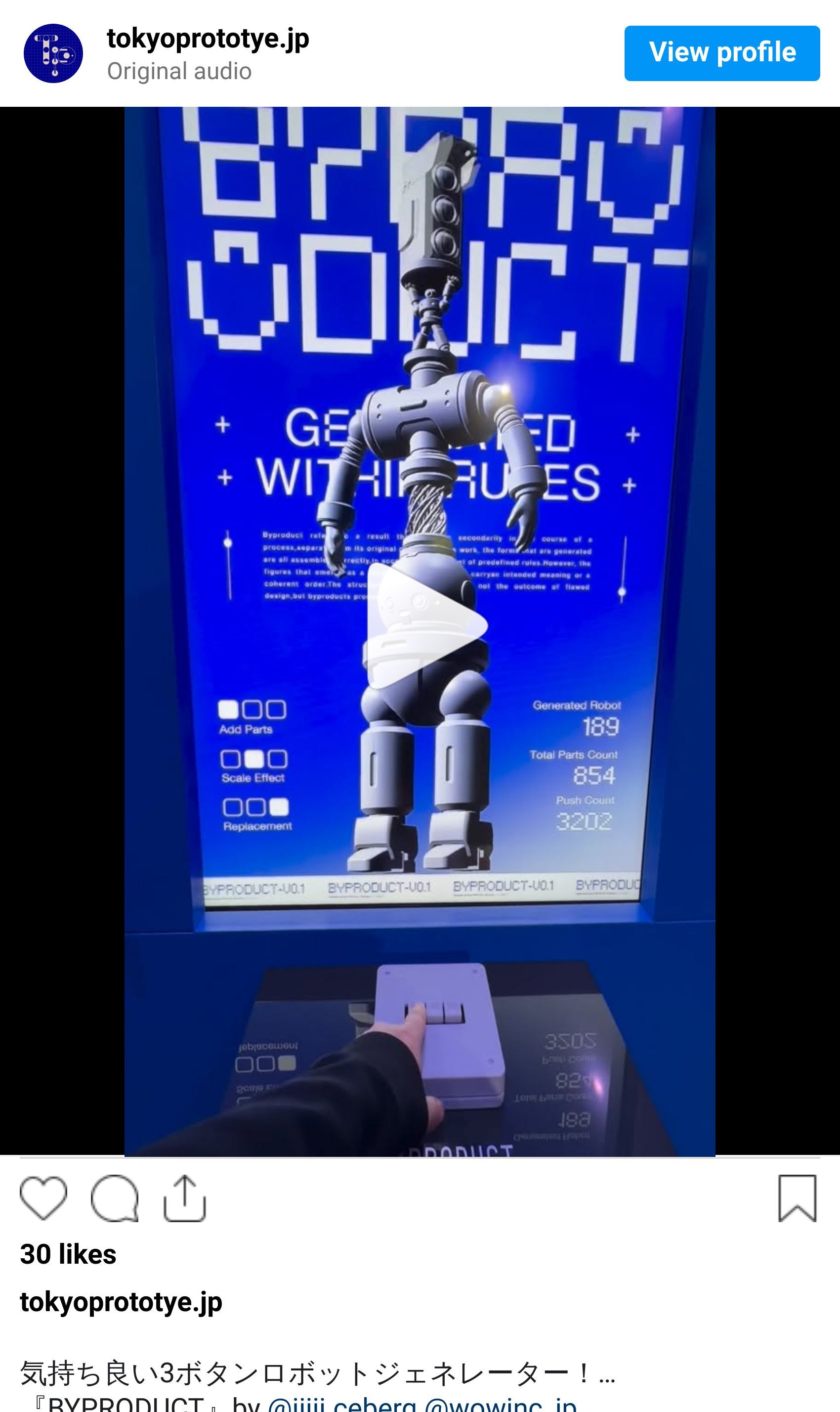
This work explores the forms of robots that emerge as a secondary byproduct of rule-based generative processes. These forms are not errors or exceptions; rather, they manifest as the result of a correctly functioning system. Through the physical structure of the robot, this project attempts to delineate the chance and distortion inherent within design and control.
Operation The system is operated using three keys. The main key stacks parts randomly, while the remaining two keys allow the user to intervene with effects such as "scale transformation" and "part replacement." Although the number of available parts is limited, the combination of the stacking sequence and the user's real-time intervention generates a vast range of robots—varying from the predictable to the completely unexpected.


Background of the Work
In my previous practice, I primarily used sculpting software such as ZBrush, focusing on the level of completion of form and the sense of pleasure derived from sculpting itself.
However, an approach that consolidates everything into a single ideal form also contains a certain rigidity: the moment it is completed, it loses the potential to expand any further. Feeling that this sense of closure was somewhat wasteful became the starting point for this work’s concept of a structure that does not converge into a single, finalized form.

Examples of Works Produced in i-ceberg’s Past Activities
Initially, I considered a structure based on my early self-made models, in which only parts and textures would be swapped. However, as someone working on the periphery of the film and video industry, I felt that simple switching alone lacked a sense of “visceral comfort.”

R&D focused on using the earliest models I created and experimenting with variations in texture.
Moreover, since the work is experiential, I developed a desire for each generated entity to possess a clear individuality and to surprise the participant. Through trial and error, I arrived at the current structure: stacking parts vertically like a totem pole and further distorting their scale. This combination of “vertical accumulation” and “distortion” became the key to dramatically transforming the robot’s impression.
Generation and Structure
At an early stage, I considered using AI generation for the parts in order to improve efficiency. However, controlling the delicate balance of “a sense of unity combined with a subtle feeling of unease” that emerges when the parts are stacked proved unsatisfying with current AI capabilities. Unwilling to spend excessive time struggling with this, I ultimately chose to create all of the roughly sixty parts by hand. It was extremely demanding.
The resulting parts are designed to function differently: some can determine the overall impression on their own, some are overtly “robot-like,” and others lack strong individuality yet drastically alter the overall silhouette. Each part thus contributes a distinct effect to the whole.

A fairly predictable, by-the-book type.

Probably not the ally type.

A type with a strong golem-like presence.

A type that looks like it would be leisurely delivering mail.
Alongside this experiential work, I am also exhibiting 3D-printed figures of robots that were physically assembled from the parts. While preparing the printable models, ideas emerged—such as “it might be fine if the torso itself is a face,” or “perhaps the arms could be attached directly to the head,” inspired by machines like those in Tengen Toppa Gurren Lagann. Moving back and forth between the physical and digital realms led to many additional insights.
As these parts accumulate, even though the fundamental rules are never broken, meanings and balances become distorted—added to, subtracted from, or at times resulting in awkward objects that do not align at all. Although the number of parts is not large, their combinations give rise to distinctive and unconventional robots.
Future Prospects
As an extension of this project, I have also released merchandise in the form of statuettes—3D-printed versions of the generated robots. Each statuette is accompanied by a fictional setting and scenario created using AI. The narratives, constructed from information inferred from the visuals, deliberately contain shifts in interpretation and ambiguity; such misreadings and fluctuations are treated as an integral part of the expression. I encourage you to purchase one and experience this aspect for yourself.

ID: #008_SOLDIER
NAME: VETERAN
The last surviving unit of a mass-produced weapon deployed in a certain interplanetary war. Hundreds of years have passed since the war ended, and the nation it once served as well as the people it was meant to protect have faded into oblivion, yet it still stands in the wasteland, continuing to obey commands that were never reset.
Going forward, I envision using this work as a stepping stone toward game-like experiences and competitive formats that take the characteristics of the generated robots as a given. In such contexts, the individual differences produced as outcomes of the rules themselves would function as elements that influence behavior and results.
This work comes into being through the intersection of the artist’s intention, the autonomy of the system, and the intervention of the participant. The robots that emerge are not “correct forms” designed by someone in advance, but temporary solutions generated by rules—entities that are simultaneously open to other possibilities. By making the process of generation itself visible and affirming its distortions and fluctuations, this work, through the motif of robots, presents not a state of “completion,” but the condition of being in continuous generation.
Credit
Maison: Hironobu Sone
Technical Director / Programmer : Yuki Horikawa
Project Manager / 3d print support : Ikumi Tabata