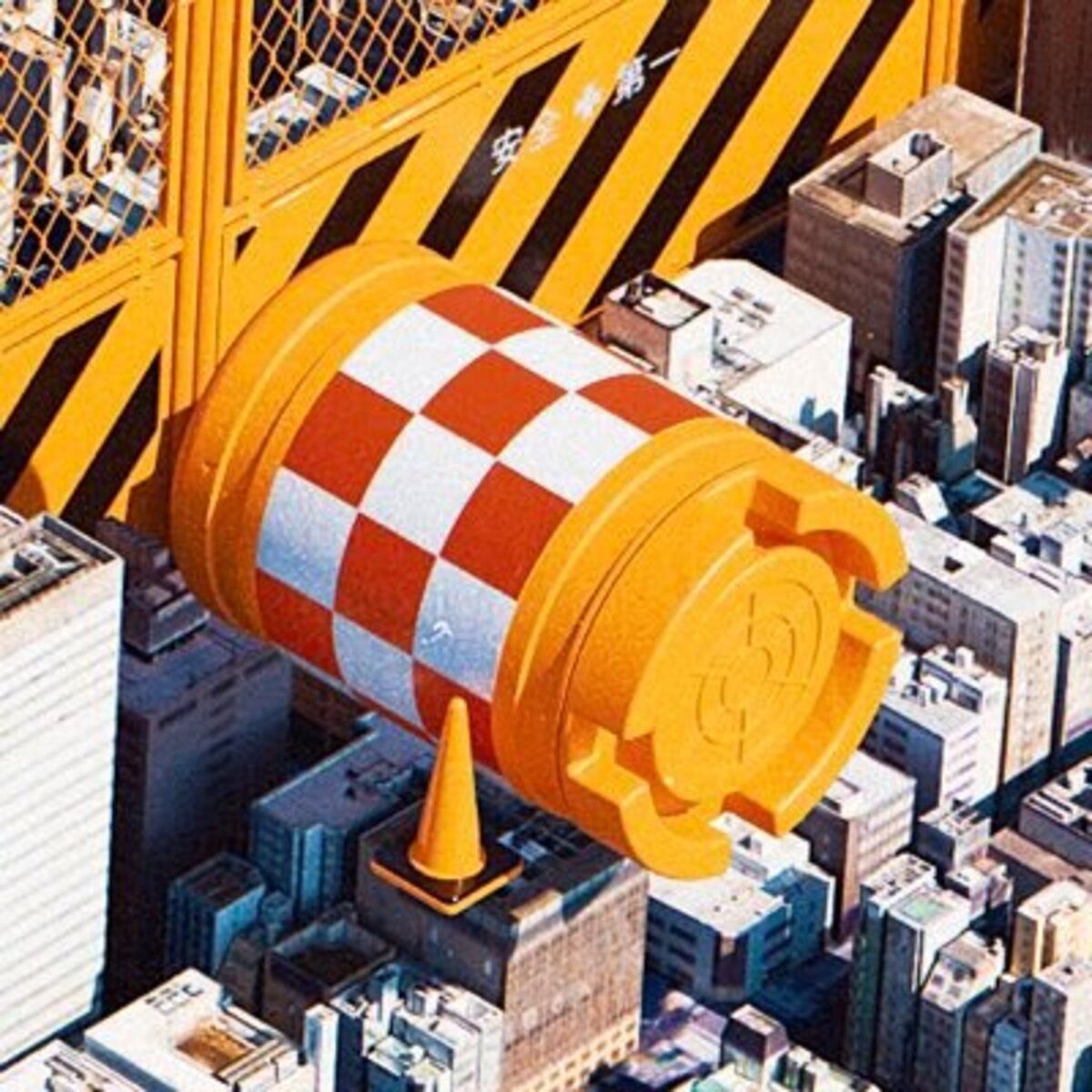
In March of this year, a large CUBE LED display was newly installed on the façade of Tamagawa Takashimaya S.C. South Building. I was invited by NEORT—who I've worked with for some time—to create the content to be screened on the new display.
/
Since it was a seasonal slot, I was given only two themes—“Futakotamagawa” and “Autumn”—and the rest was left entirely up to me. The production period fell in that ambiguous mid-summer timing, so while wondering, “Is there even any ‘autumn’ yet?”, I decided to start by going out for research anyway. Things don’t begin until I walk the place myself.

Futakotamagawa Station, where the Den-en-toshi Line and the Oimachi Line intersect
I used to live along the Oimachi Line, so I’ve always felt a certain familiarity with “Nikotama.” Locals, however, seem to call it “Futako.”

Stepping out of the station gate, Tamagawa Takashimaya S.C. and the massive cube come immediately into view on the left. The work being screened at that moment was by video artist Toshiki Okamoto. Since his piece was also themed around Futakotamagawa, I found myself thinking, “Ah, someone has already tried various approaches here,” as I watched.
Although the cube is made up of flat surfaces, when you see it in person it has a surprisingly strong objecthood. I felt it might work better if treated as an abstract object rather than relying on cuts or narrative sequence. There’s a terrace-like viewing space around it where you can get quite close. Large-scale media installations are usually meant to be seen from afar, so its spatial distance felt unusual.
The café near the rooftop garden, despite its great location, is oddly quiet—almost like a hidden spot to relax.
After giving the cube a thorough look, I decided to walk around the surrounding neighborhood.

Behind Tamagawa Takashimaya S.C., restaurants cluster together, and tiled or brick-paved alleys extend through the area. The blocks are small but carefully maintained and neatly arranged. Still, within the larger Futakotamagawa area, I always sensed something slightly different in the air here.


To me, Futakotamagawa has the strong impression of a “well-arranged miniature world,” where the colossal “Futakotamagawa Rise” sits attached to the station like a giant spaceship. Parks along the riverbank and commercial facilities are all neatly arranged, and the atmosphere of upscale residential areas like Jiyugaoka, Fukazawa, and Todoroki coexists with a more casual, shopping-mall sensibility. It feels like a carefully organized, intentionally designed city, built for comfortable living.

Within that, the back side of Takashimaya has a faint trace of irregularity and warmth. The texture of the bricks and the deep orange tones stuck with me as I walked.

Now I headed to the opposite side of the station, toward Futakotamagawa Rise.
The two sides of the station are divided by white-and-blue elevated tracks, on which the Den-en-toshi and Oimachi lines run.

The large galleria hosts events every weekend, bustling with families. I don’t fully understand what a “marche” strictly is, but I’m fairly certain they hold something marche-like here on a regular basis.

Deeper inside are Tsutaya Electrics and 109 Cinemas—everything one might need for a leisurely weekend. At this 109 Cinemas, a Mercedes-Benz dealership commercial plays before every film. And indeed, there are an absurd number of Mercedes driving around this area. Perhaps people really do go, “Should we just buy one on the way home from the movie?”

Walking along the promenade, the Futakotamagawa Rise Tower & Residence Tower—so-called “tower mansions”—stand tall. Because the riverside area has few other tall buildings, the white tower and the vast sky above it become striking. As I walked, I found myself thinking again, “This city has an impressively wide sky.”

A little further on, just before reaching the riverbank, I suddenly came across a Japanese-style garden called Kishin-en. Again, I was reminded of the miniature, curated feeling of this city.

Right before the Tama River sits what I personally consider the best-located café in the area: Starbucks Coffee Futakotamagawa Park Store. People here seem to spend time simply “being,” and the atmosphere is always pleasant.

I wandered around the riverside for a while. The sun was still strong, so it felt more like late summer than autumn, but the colors of the greenery seemed to be slowly drifting toward reddish browns.


As I walked back and forth between the Takashimaya side and the Rise side along the riverbank, the sun began to set. A slightly cold breeze blew through; sunlight reflected sharply off the water’s surface beneath the tall sky. It felt like I had finally found a trace of “autumn.”


On the large steps, people were spending time in their own ways, watching the sunset.

After returning home, I began sketching the day’s scenery in CG, thinking, “It felt something like this, I think,” as I arranged the elements.

I collected materials and elements and began reconstructing them. If I let things scatter too much, the piece wouldn’t hold together, so I decided to unify it through colors. The orange tones from behind Takashimaya at dusk, the greens of the riverbank and overpasses, the blues and whites of the elevated tracks, the sky, and the apartment buildings. They happened to link with the colors of the Oimachi and Den-en-toshi lines, which felt just right. Missing materials led me to revisit the area several times afterward.

Testing projection ideas in 3D
Typically, an LED display is used to broadcast externally produced content, making it feel foreign to its surroundings. But by editing the local landscape and returning it to the LED, perhaps the device itself might begin to resemble a portal—an opening or singularity carved into the space.
Until now, my process had ended at collecting and reconstructing surrounding elements. But by returning the images to the original landscape, perhaps the reconstruction itself could appear as a kind of “phenomenon.”
As I decomposed urban elements and treated them as patterns, I began to feel as though I was creating camouflage. Maybe contemporary urban camouflage looks something like this, I thought, imagining it plastered onto a tank.

At one point, Aramaki told me, “It feels like you’re treating the elements as material for gags.” I agreed, and also felt that—without realizing it—I might be reducing them to surface-level “relatable jokes.” That bothered me.
Part of me does enjoy the playful, almost game-like aspect of such material. But another part wants to shift the perspective—make things look strange, abstract, highlight the oddness of shapes and scenes.
When something deliberately curated ends up appearing like a “phenomenon,” as if slightly supernatural or uncanny, it becomes interesting. That moment when the work slips out of my hands and transforms into something else—that’s the most exciting part for me.

ORANGE

BLUE

GREEN
At some point, I stopped wanting to fully control my works. That might be due to getting used to the unpredictability of collective creation within Tsuribu Tokyo.
I’ve always been bad at ball games. When trying to dribble, I often couldn’t control the ball at all; it would run off in some direction and I’d end up chasing it. All I saw was the ball rolling away—not the surroundings. By the time I looked up, I’d be standing somewhere unfamiliar.
I still feel something similar today: in making things, I am sometimes pulled along by the work itself. Of course, much of the process involves careful planning, and when things drift too far I forcefully steer them back. But beyond that, I enjoy the unpredictability—the part that leads me somewhere unexpected.


When I saw the finished work installed in the city, I had the usual thoughts—“This part worked well,” “That part could have been better”—but I also felt it had already slipped out of my hands and begun to exist on its own.
A friend messaged me saying they had seen it: “That part looked like it was glitching.”
I was strangely happy to hear that.

Among the colors, the green had a particularly uncanny presence. I’m quite fond of it.